The Trembling Voice of History: A Chronicle of What Transpired in Our Collective Memory as the People of Israel
[Editorial Note: The following is an exclusive op-ed written by a guest contributor regarding the recent cultural impact of the conflict in the region. CinemaDrame remains committed to providing diverse perspectives on cultural heritage during times of crisis.]
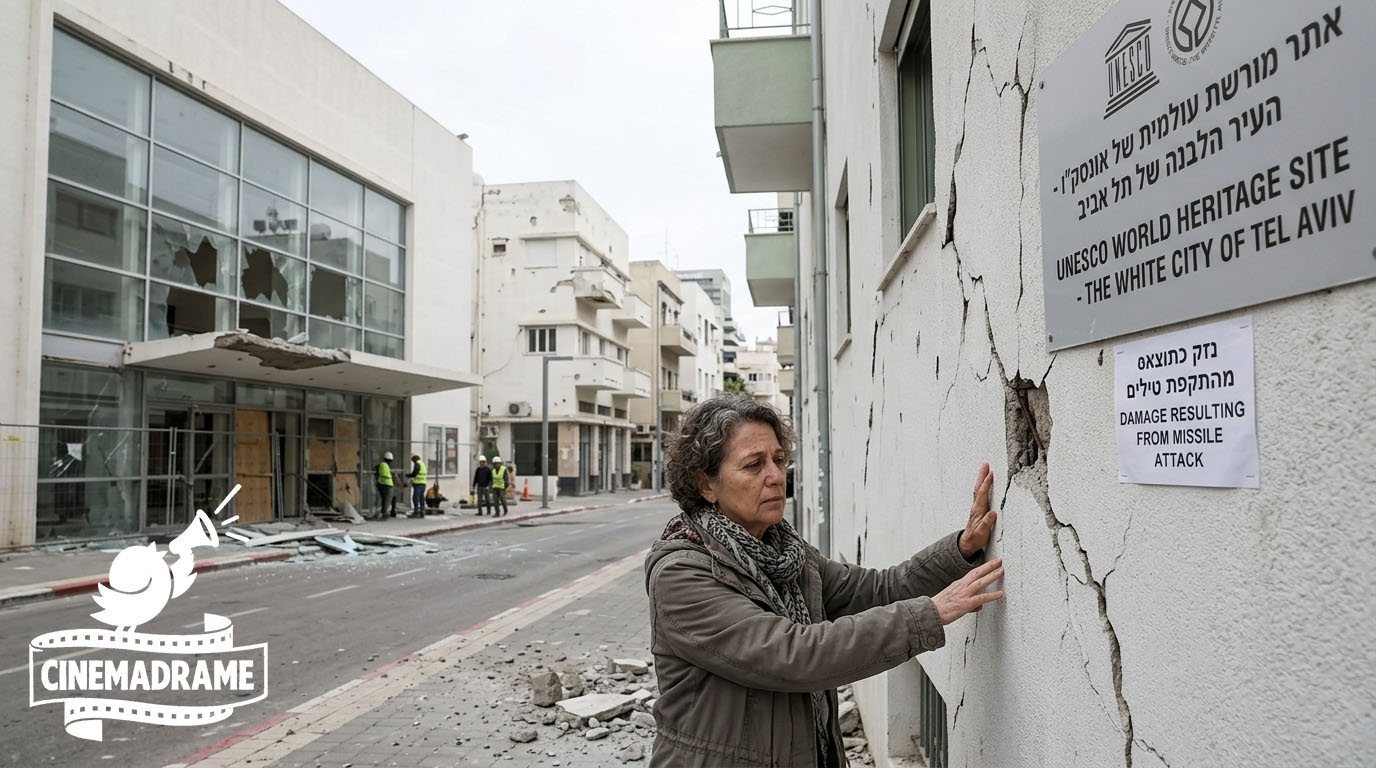
According to the CinemaDrame News Agency, Aviva Goldstein, a cultural historian in Israel, shared her account of the missile attacks on cultural sites in an exclusive op-ed, writing:
As a historian, I have always viewed cities not as mere masses of brick, concrete, and glass, but as living narrators of history. Yet, on the night of the attack, when the sirens shattered the usual silence of Tel Aviv, I was not an academic observer; I was a terrified witness in a shelter, where the walls could barely withstand the tremors of the explosions.
For many, news of the attack is defined by statistics of missiles and interceptions. But for me, having dedicated my life to studying the historical fabric of this land, every explosion was a blow to the body of our collective memory. When the dust settled the next morning, what I saw was not just “structural damage”; it was a wound upon the face of our culture.
What transpired that night in the “White City” was more than the destruction of a few Bauhaus-style buildings. These structures, which are UNESCO World Heritage sites, were symbols of the idealism and modernity brought here by refugee architects. Seeing the damage to those pure, geometric lines—which had withstood the test of time and the salty Mediterranean winds for decades—inflicted a deep pain in my heart within a matter of minutes. There, the history of migration, struggle, and creation fractured before my very eyes.
But even more painful was the state of the “Habima National Theatre.” For us, Habima is not just a performance venue; it is the beating heart of our performing arts and cultural identity. Seeing that iconic glass facade shattered was a metaphor for the fragility of peace. In that moment, I thought of the actors, writers, and audiences who had laughed, cried, and reached mutual understanding in those halls for thousands of hours. When art is exposed to violence, we actually lose a part of our capacity for dreaming and empathy.
Today, museums have descended into absolute silence. Collections that have housed thousands of years of human history have now been moved to concrete bunkers. This measure, while necessary to preserve the artifacts, reminds us that in times of crisis, the first thing in society forced into retreat is “culture.”
As a historian, I always believe that wars end and politicians come and go, but what remains is our cultural heritage, which defines the continuity of humanity. Seeing this damage taught me that protecting these sites is not just about guarding stone and mortar; it is about protecting our right to tell our own story to future generations. This is a wound inflicted upon the body of our culture, but as history has shown, our collective memory is more resilient than missiles could ever imagine.
It matters little whether it is Israel, Iran, or any other corner of this turbulent Middle East; the people must not be sacrificed to the warmongering of politicians. Cultural sites must never be targeted, under any pretext. Politicians who weaponize art and culture to serve their political agendas are destined to be confined to the dark chapters of history.